Interview: Franki Sparke
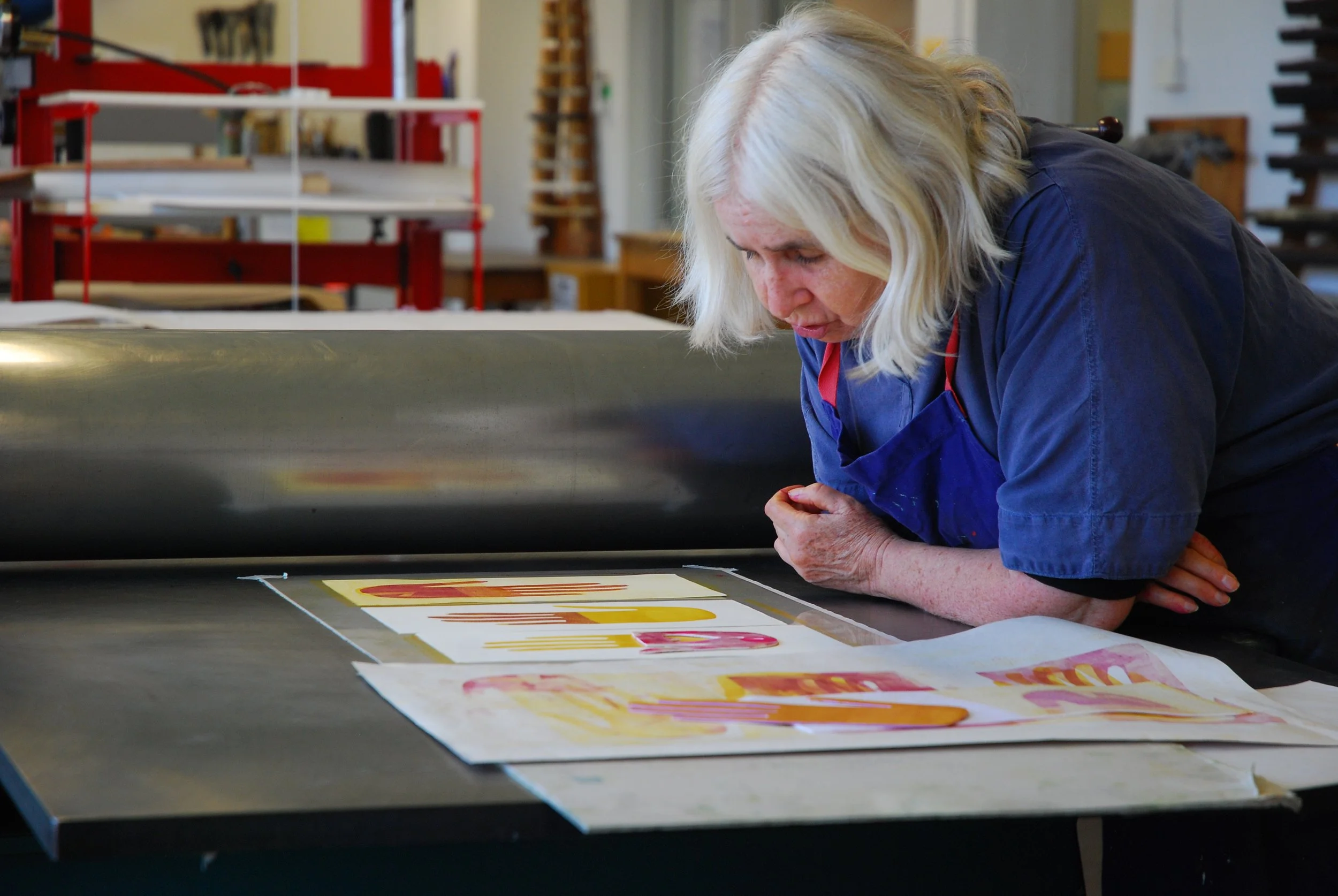
Earlier this year, we sat down with artist Franki Sparke to ask about her practice, and the early days of printmaking at Megalo and Studio One.
This Thursday 22 October Megalo is participating in AusArt Day, a national day of giving with Creative Australia.
We believe art gives back to the community through a diversity of voices and new perspectives. Your support will enable artists to sustain a creative career, and connect ambitious ideas with people. Help us reach our goal of $6000 to provide vital upgrades to one of Australia’s only galleries dedicated to sharing print and works on paper, so artists can continue to create and connect to share their stories.
Learn more or make a donation.
What do Megalo’s studios offers you as an artist?
Ohh. Apart from the fact that you offer all the equipment that I can’t have in my own space, it allows me to work around other people. So there’s the social aspect, which is becoming more important to me.
If I can come here, I can have a conversation about my work that I can’t have by myself, like we are now. There's something very lovely about the printmaking community, I don’t know if that’s typical of Canberra or printmaking generally, but it’s very vertically orientated. It's got a whole range of very young people through to old people, and I like that about it. There’s a camaraderie involved across generations and the exchange of ideas. The arts is a good place for that to happen, and printmaking is a great forum for that. Megalo in particular is a great place for that to happen, because it's the sort of place it is, so there’s a really nice mix of community. You’ve got people from Hans On who come in, and residents who come in from all over the country and all over the world, and meet them and that’s really interesting. You’ve got very professional artists and people who have taken it up for the first time and are doing it in their spare time. I actually don’t know if another place exists that is quite like Megalo. Your residencies programs are the most generous in Australia. You also have accommodation, and that’s very unusual. A lot of the time you have to give lectures or hold your own class. Every time I look across Australia, I still think the best ones are at Megalo.
I haven’t seen a workshop as good as Megalo. There was a point in my life that I stayed in Canberra because of Megalo. It made a difference for me, and I think it's worth staying in Canberra for.
How long have you been coming to Megalo?
So I remember Megalo when it was in Ainslie Village, I’ve been coming into Megalo since it was born. I remember the people who created it. I went to art school with them. Two of them were involved in setting up Studio One, someone else was involved in setting up Megalo. I was about to have some kids, so I was working from home but I did some community arts project when they were still at Ainslie Village, and then I followed them through Hackett and then Watson. So I remember its whole life. I remember when nobody knew what Health and Safety meant. Screenprinting in the seventies, you cleaned the screens with acetone. Megalo is definitely the best facility it's ever had.
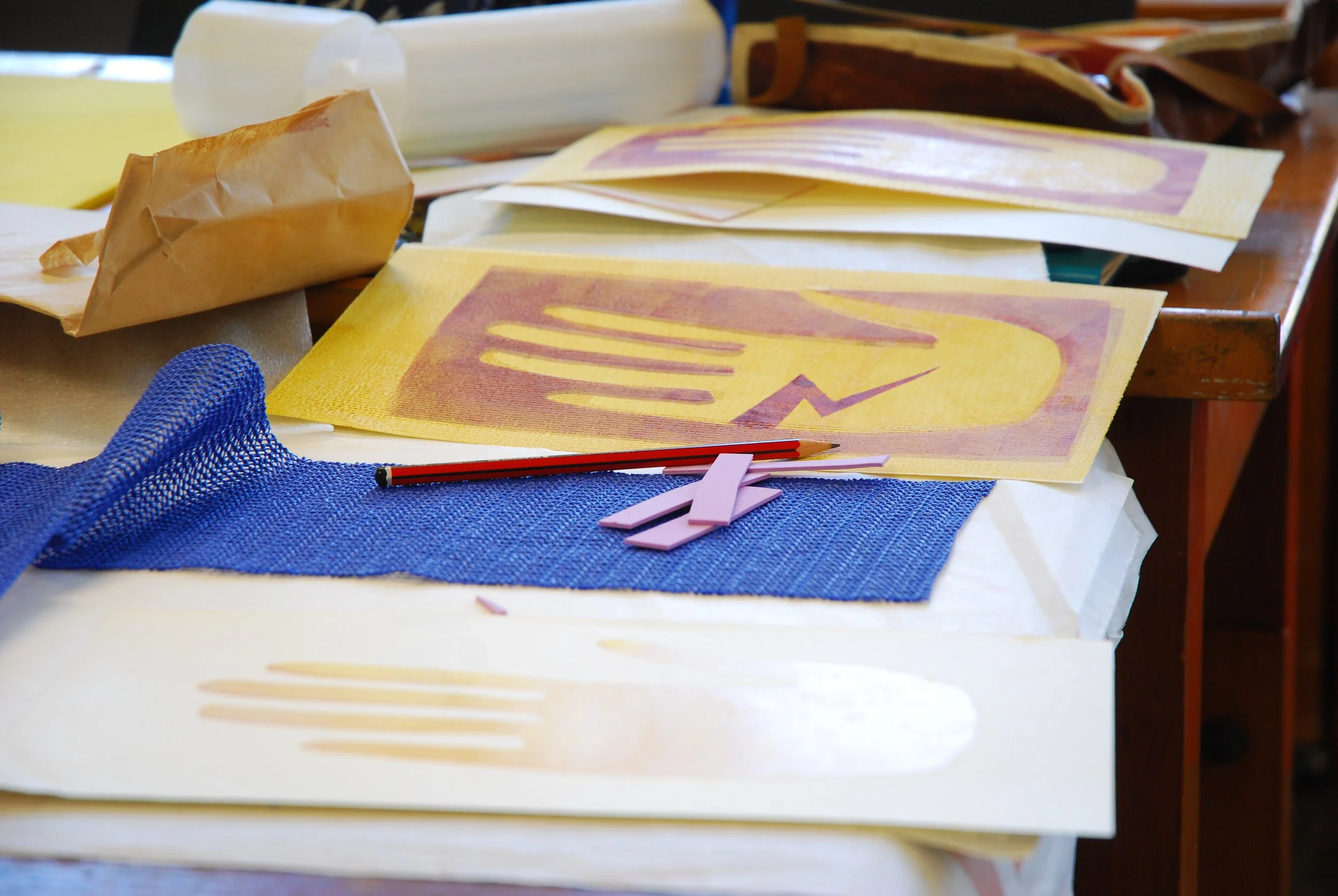
Early on I did a lot of community arts projects. Using relief printing as part of the Backyard Project, we were working with women with kids. I fell into relief printing for practical reasons, and then I just thought “wow, relief printing is amazing”. So I did the first Backyard Project, and then another one later. Paul Costigan got me involved in that. The Backyard Project began when Megalo was still at Ainslie Village.
Can you talk a little about how you work back and forth between analogue and digital processes.
It took me a long time to come around to digital processes, around 2000 I think. Everything I can do with Adobe Creative Suite is unbelievable to me. I remember when things were pasted up, I remember letraset - all those things were so fussy and you would have to rough things up in different colours and that sort of thing.
Digital output is never as beautiful as what I do here. But I don’t always start with analogue, sometimes I start with drawings on an Ipad because it's very easy to draw things up, wipe it, draw things up again. Then I convert it to an actual woodcut. But I would never output them and use them as a digital drawing, they don’t look as interesting. There’s a weird problem that your work only gets better if you make mistakes. Computers can make everything pixel perfect, and can become predictable in a way. I think it's a constant juggling between the two, then once I have something analogue I really love, then I scan it. And once you scan something tiny, and make it huge, then that’s something wonderful.
I often work with rubber stamps, which is limited to about the size of your hand. You can print them with your hand pressure, so they’ve got to be small and a little bit squidgee. If you print it that small it has a limited use in the world, but if you scan it you can make it much bigger and you can get all that grungy, scridgy, gritty look of something that’s real and has been cut by hand. The first time I saw my work blown up and projected, which I did with John Pratt, I was able to blow it up and project it onto the side of the NGA with all the mistakes. Or I can scale things and then play with them and print them on the RISO.
That shift of scale is something I’m only able to do digitally, and that’s something I do all the time. Changing the scale is a really essential part of everything I’ve done for a really long time.
SUPPORT ART FOR EVERYONE.
Create a space for artists to share their voice this AusArt Day, 22 October 2026.
Your donation will enable important upgrades to our gallery, and ensure that artists continue to have the opportunity to tell their story through exhibitions, diverse public programs and online platforms.
Help us reach our goal of $6000 to provide vital upgrades to one of Australia’s only galleries dedicated to print, so artists can continue to create and connect.